Albums / Austria — Notgeld
Austria — Notgeld
The small-change emergency of 1919–21, when several thousand Austrian communes printed their own Heller notes against a shortage of coin — and then kept printing them for the collectors.
50 notes · 1918–1920
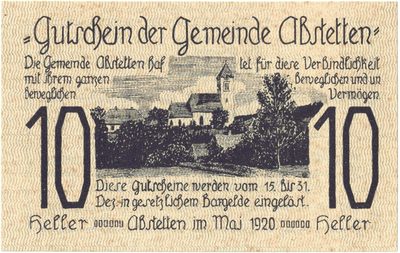
10 Heller, Gemeinde Abstetten, 1920
— · OM-00291 · UNC
← → to move · space to play · F to flip
This copy
- Accession
- OM-00291
- Series year
- 1920
- Actually issued
- 1920
- mayor
- J. Brandsteidl (J. Brandsteidl)certain
- Grade
- UNC (IBNS)
- Estimated value
- $7indicative
- Dimensions
- 79.5 × 50.7 mm (±0.6)
The type
- Type
- 10 Heller, Gemeinde Abstetten, 1920
- Rarity
- very common
- Themes
- Notgeld Emergency money Lower Austria Verse Collector series First Austrian Republic
Inscriptions
Heimset fleissig ein, Ihr Sammler all! Nehmt auch uns're Schein' auf jeden Fall!
Collect away, all you collectors! Be sure to take ours too!
Dieser Gutschein wird vom 15. bis 31. Dezember 1920 an der Gemeindekasse gegen 10 Heller oe. W. eingeloest. Die Gemeinde hat hiefuer einen eigenen Deckungsbetrag hinterlegt. Nachahmung und unbefugter Verschleiss wird gesetzlich bestraft. Abstetten, im Mai 1920. Der Buergermeister: J. Brandsteidl.
This voucher will be redeemed at the commune treasury for 10 Heller Austrian currency between 15 and 31 December 1920. The commune has deposited a separate cover sum for the purpose. Counterfeiting and unauthorised sale are punishable by law. Abstetten, May 1920. The mayor: J. Brandsteidl.
Symbology
- The verse
- Austrian and German emergency money of these years is full of rhyme. Partly it fills space cheaply; partly a jingle makes a worthless-looking slip of paper feel like something a neighbour made. Abstetten's verses do both jobs and then name the real customer outright.
- The scene
- The face shows the parish church of Abstetten behind its trees - one parish landmark per denomination, so that the three notes together make a small portrait of the commune.
- Deckungsbetrag
- The promise that a matching sum has been set aside. It is the only thing standing between this note and worthlessness, and every Austrian commune note says some version of it.
- oe. W.
- *oesterreichische Waehrung* - Austrian currency. Worth stating in 1920, when Habsburg Kronen were still circulating in half a dozen successor states and each was busy overstamping them into something national.
What was happening
Austria in 1919 was a republic of six and a half million people left holding the currency of an empire of fifty. The Austro-Hungarian Bank was in liquidation, the peace treaties had cut the country off from most of its coal and much of its food, and small coin simply vanished: hoarded against worse to come, melted for the metal, or carried across the new frontiers where it bought more. Shops could not give change, and a country that cannot give change cannot trade.
So the communes printed their own. A council resolution, a local printer, a redemption date and the pledge of the commune's entire movable and immovable property - that was the whole legal apparatus behind several thousand separate issues of Heller notes between 1919 and 1921. Vienna tolerated it while it solved a real problem and moved to stop it in 1920, by which time the notes had found a second market: collectors would pay more than face value for a complete set, so a village could raise real money by printing money it hoped would never be presented. The artwork improved as the need receded.
Abstetten is a small commune in the Tullnerfeld, the plain west of Vienna. Its three notes are dated May 1920 and were redeemable in the last fortnight of December that year, on the signature of the mayor J. Brandsteidl. What makes them worth reading is the verse. Each denomination carries four lines of doggerel on the back, and between the three of them they admit exactly what this money was for:
Wir grenzen an das Tullnerfeld / Und leiden auch in herber Not. / Nun schufen wir papier'nes Geld / Zu kaufen drum das liebe Brot.
we border the Tullnerfeld and we too are in bitter need, so we have made paper money to buy our daily bread with. And then, on the ten:
Heimset fleissig ein, / Ihr Sammler all! / Nehmt auch uns're Schein' / Auf jeden Fall!
collect away, all you collectors, and be sure to take ours too. The same set of notes pleads poverty and solicits the collector trade, four lines apart.
This account belongs to the type, not this copy — it is shared by every 10 Heller, Gemeinde Abstetten, 1920 in the collection.