Albums / Germany
Germany
The national paper money of Germany, apart from the Notgeld — a 1917 prisoner-of-war Mark, the inflation Reichsbank note of 1922, the stabilised Reichsmark and Rentenmark of the Weimar and Nazi years, and the Reichskreditkassen scrip that paid the Wehrmacht across occupied Europe.
14 notes · 1914–1942
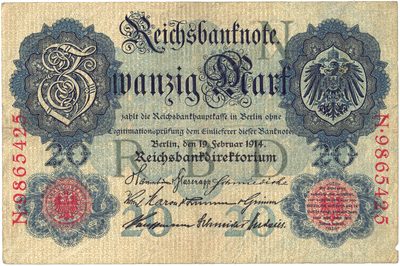
20 Mark, Reichsbanknote, 1914
N 9865425 · OM-00615 · VF
← → to move · space to play · F to flip
This copy
- Accession
- OM-00615
- Serial
- N 9865425
- Series year
- 1914
- Actually issued
- 1914
- Signatures
- No bank officer signature on this issue.
- Grade
- VF (IBNS)
- Dimensions
- 137.5 × 91.3 mm (±0.5)
The type
- Type
- 20 Mark, Reichsbanknote, 1914
- Printer
- Reichsdruckerei, Berlin
- Rarity
- common
- Themes
- German Empire Reichsbank WWI Imperial eagle
Symbology
- Imperial eagle
- The single-headed eagle of the German Empire, emblem of the Reich under whose authority the Reichsbank issued the note.
- Reichsbankdirektorium
- The note is issued in the name of the Reichsbank Directorate in Berlin, the central board that governed the bank; its members signatures were printed, not hand-written.
- Ornate blue-green guilloche
- Dense machine-engraved lathework in blue and green, both decoration and anti-forgery device, in the confident style of a pre-war imperial currency.
What was happening
This note is dated Berlin, 19 February 1914, in the last months of peace, and it belongs to the mature Reichsbanknote design that the Reichsbank had been issuing since 1908. When war came that August, gold and silver coin vanished almost overnight and paper of exactly this kind became the everyday money of the Empire. The Reichsbank simply kept the plates running, so a note conceived before the war ended up financing it.
The engraving is deliberately imperial. An ornate blue-green frame surrounds panels of guilloche and allegory, the text names the Reichsbankdirektorium — the governing board of the central bank — and the imperial eagle presides over the design. Notes of this era carried the printed signatures of the directorate members rather than hand-signing, and the obligation on the face promised payment by the Reichsbank's main cashier in Berlin.
The twenty-mark denomination sat just above the small change of the day and circulated hard. Printed by the Reichsdruckerei in Berlin on watermarked paper, it has no modern security thread; its defences were the watermark, the fine guilloche, and the sheer familiarity of the design. By 1923 twenty marks would not buy a postage stamp, and vast numbers of these notes were set aside, which is why they remain so plentiful today.
This account belongs to the type, not this copy — it is shared by every 20 Mark, Reichsbanknote, 1914 in the collection.