Albums / Mongolia
Mongolia
The first tögrög of democratic Mongolia — the 1993 decimal series printed by De La Rue after the 1990 revolution, with the herdsman-revolutionary Damdin Sükhbaatar on the small möngö and tögrög notes and Chinggis Khaan, suppressed through seventy Soviet years, restored to the large ones.
6 notes · 1993–1993
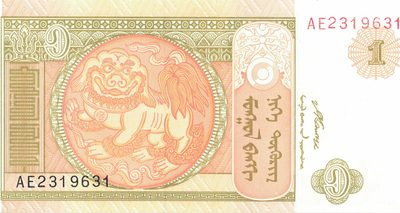
1 Tögrög, Mongolbank
AE 2319631 · OM-00594 · UNC
← → to move · space to play · F to flip
This copy
- Accession
- OM-00594
- Serial
- AE 2319631
- Series year
- 1993
- Actually issued
- 1993
- Signatures
- No bank officer signature on this issue.
- Grade
- UNC (IBNS)
- Dimensions
- 103.9 × 55.1 mm (±4.2)
The type
- Type
- 1 Tögrög, Mongolbank
- Printer
- Thomas De La Rue, London
- Rarity
- common
- Themes
- Modern Mongolia Soyombo Arslan
Symbology
- Arslan
- The guardian lion of Mongolian Buddhist tradition, a protective temple figure derived from the Asian lion motif, shown here in a decorative roundel.
- Soyombo
- The national emblem of Mongolia — fire, sun, moon and the taijitu arranged in a column — that stands at the hoist of the state flag and marks the country's sovereignty.
What was happening
The tögrög has been Mongolia's unit of account since 1925, but this one-tögrög note is part of the country's first genuinely independent coinage of the modern era, the 1993 series issued by a Mongolbank newly separated from the state treasury after the fall of communism. The whole series was printed by Thomas De La Rue in London and, unlike the Soviet-era tögrög that bore Sükhbaatar and socialist scenes, the smallest notes lean entirely on traditional and religious iconography.
This note carries no portrait. Its design centres on an Arslan — the lion-like temple guardian of Mongolian and wider Buddhist tradition — set in a roundel, with the Soyombo emblem and the vertical Mongolian script completing a wholly national face. Printed vertically like the möngö fractions, it was among the first denominations to be made meaningless by the inflation of the 1990s, and single tögrög notes now circulate mainly as keepsakes and in collectors' sets.
This account belongs to the type, not this copy — it is shared by every 1 Tögrög, Mongolbank in the collection.