Albums / Yugoslavia
Yugoslavia
One dinar across two states — the banknotes of socialist Yugoslavia from 1968, and the hyperinflation of the rump Yugoslav federation in 1992–93, when the bank that had printed a ten-dinara metalworker was printing five-million-dinara notes.
14 notes · 1968–1993
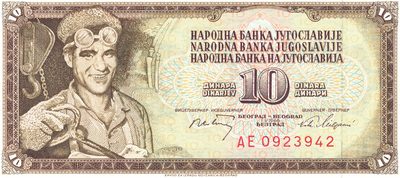
10 Dinara, SFR Yugoslavia, 1968
AE 0923942 · OM-00545 · VF
← → to move · space to play · F to flip
This copy
- Accession
- OM-00545
- Serial
- AE 0923942
- Series year
- 1968
- Actually issued
- 1968
- Signatures
- No bank officer signature on this issue.
- Grade
- VF (IBNS)
- Estimated value
- $3indicative
- Dimensions
- 124.9 × 53.6 mm (±3.2)
The type
- Type
- 10 Dinara, SFR Yugoslavia, 1968
- Portrait
- Arif Heralić
- Printer
- Zavod za izradu novčanica, Beograd
- Rarity
- common
- Themes
- Socialist Yugoslavia Industry Portrait
Symbology
- Arif Heralić, the Zenica steelworker
- A real foundry worker from the Zenica steelworks whose photographed likeness became the face of Yugoslav industrial labour on the dinar.
What was happening
The money of Tito's Yugoslavia at its mid-century height. This 10 dinara note, dated 1 May 1968 — May Day — carries one of the most reproduced faces in Yugoslav life: the Zenica steelworker Arif Heralić (1922–1971), lifted from a famous 1954 photograph and used on the dinar for years as the emblem of socialist self-management and heavy industry. He wears the goggles pushed up on his cap, the blast furnace behind him.
The reverse is purely ornamental, large value numerals in a guilloche, printed at the Zavod za izradu novčanica in Belgrade. See also the 1978 reissue ([[yugoslavia-10-dinara-1978]]).
This account belongs to the type, not this copy — it is shared by every 10 Dinara, SFR Yugoslavia, 1968 in the collection.