Types / 1920
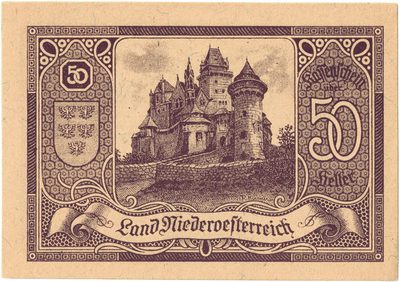
50 Heller, Land Niederoesterreich, 1920
Kassenschein des Landes Niederoesterreich ueber fuenfzig Heller
What was happening
Austria in 1919 was a republic of six and a half million people left holding the currency of an empire of fifty. The Austro-Hungarian Bank was in liquidation, the peace treaties had cut the country off from most of its coal and much of its food, and small coin simply vanished: hoarded against worse to come, melted for the metal, or carried across the new frontiers where it bought more. Shops could not give change, and a country that cannot give change cannot trade.
So the communes printed their own. A council resolution, a local printer, a redemption date and the pledge of the commune's entire movable and immovable property - that was the whole legal apparatus behind several thousand separate issues of Heller notes between 1919 and 1921. Vienna tolerated it while it solved a real problem and moved to stop it in 1920, by which time the notes had found a second market: collectors would pay more than face value for a complete set, so a village could raise real money by printing money it hoped would never be presented. The artwork improved as the need receded.
Lower Austria did at province scale what its villages were doing at parish scale, and did it with a balance sheet behind it. A resolution of the provincial parliament on 23 June 1920 authorised a further three million Kronen of treasury notes in 10, 20 and 50 Heller, pledged against the whole movable and immovable property of the province, redeemable at the provincial revenue office in Vienna in the last fortnight of December 1920. They were printed by the provincial railway's own press and every one in this series is marked II. Auflage - a second printing, because the first had not been enough.
The designs are the best argument for why people collected these. Instead of arms and formulae, the three notes show a herd being driven to water, a castle, and a wooded valley: the province advertising itself as a place worth visiting, on the money it printed because it had run out of coins.