Types / 1920
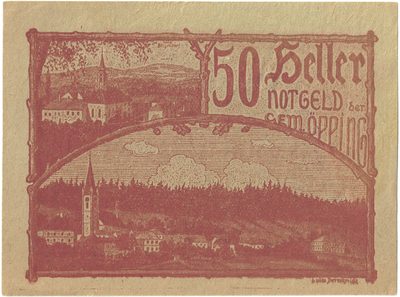
50 Heller, Gemeinde Oepping, 1920
Notgeld der Gemeinde Oepping
What was happening
Austria in 1919 was a republic of six and a half million people left holding the currency of an empire of fifty. The Austro-Hungarian Bank was in liquidation, the peace treaties had cut the country off from most of its coal and much of its food, and small coin simply vanished: hoarded against worse to come, melted for the metal, or carried across the new frontiers where it bought more. Shops could not give change, and a country that cannot give change cannot trade.
So the communes printed their own. A council resolution, a local printer, a redemption date and the pledge of the commune's entire movable and immovable property - that was the whole legal apparatus behind several thousand separate issues of Heller notes between 1919 and 1921. Vienna tolerated it while it solved a real problem and moved to stop it in 1920, by which time the notes had found a second market: collectors would pay more than face value for a complete set, so a village could raise real money by printing money it hoped would never be presented. The artwork improved as the need receded.
Oepping is in the Muehlviertel, close to the Bohemian border. Its council resolved on 11 July 1920 to issue forty-five thousand Kronen of vouchers, and - unlike almost every other note here - named no expiry date at all: redemption at the parish treasury bis Widerruf, until called in.
The design is a single red-brown woodcut printed edge to edge: the village along its ridge, the church tower on the left, the hills behind, and an arc of hand-cut lettering across the top right reading 50 Heller Notgeld der Gem. Oepping. Everything is drawn, including the letters.