Types / 1920
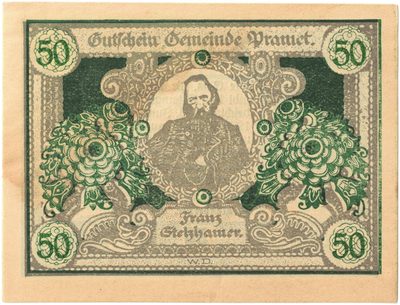
50 Heller, Gemeinde Pramet, 1920
Gutschein der Gemeinde Pramet
What was happening
Austria in 1919 was a republic of six and a half million people left holding the currency of an empire of fifty. The Austro-Hungarian Bank was in liquidation, the peace treaties had cut the country off from most of its coal and much of its food, and small coin simply vanished: hoarded against worse to come, melted for the metal, or carried across the new frontiers where it bought more. Shops could not give change, and a country that cannot give change cannot trade.
So the communes printed their own. A council resolution, a local printer, a redemption date and the pledge of the commune's entire movable and immovable property - that was the whole legal apparatus behind several thousand separate issues of Heller notes between 1919 and 1921. Vienna tolerated it while it solved a real problem and moved to stop it in 1920, by which time the notes had found a second market: collectors would pay more than face value for a complete set, so a village could raise real money by printing money it hoped would never be presented. The artwork improved as the need receded.
Pramet is a village in the Innviertel, and it had one thing worth putting on money: Franz Stelzhamer was born here in 1802.
Stelzhamer wrote in the Upper Austrian dialect at a time when dialect was what you spoke and High German was what you wrote, and he made literature of it. The province adopted one of his poems as its anthem. Pramet put his portrait in the middle of its fifty-Heller note, set his name beneath it in plain capitals, and gave the reverse to two small woodcuts of the rooms he grew up in - 's Vaderhaus, the father's house, and 's Muadastuebl, the mother's parlour - each with a verse of his underneath, in the dialect.
There is no landscape and no church. A commune of a few hundred people spent its entire note on a poet and the two rooms he came from, and printed his language on it rather than the language of the state.