Types / 1920
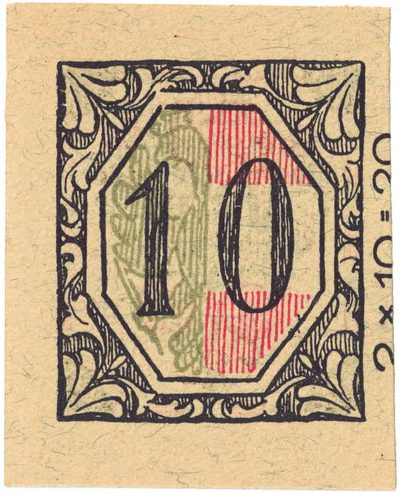
10 Heller, Marktgemeinde Telfs, 1920
Kassenschein der Marktgemeinde Telfs
What was happening
Austria in 1919 was a republic of six and a half million people left holding the currency of an empire of fifty. The Austro-Hungarian Bank was in liquidation, the peace treaties had cut the country off from most of its coal and much of its food, and small coin simply vanished: hoarded against worse to come, melted for the metal, or carried across the new frontiers where it bought more. Shops could not give change, and a country that cannot give change cannot trade.
So the communes printed their own. A council resolution, a local printer, a redemption date and the pledge of the commune's entire movable and immovable property - that was the whole legal apparatus behind several thousand separate issues of Heller notes between 1919 and 1921. Vienna tolerated it while it solved a real problem and moved to stop it in 1920, by which time the notes had found a second market: collectors would pay more than face value for a complete set, so a village could raise real money by printing money it hoped would never be presented. The artwork improved as the need receded.
Telfs is a market town in the Tyrolean Oberinntal, west of Innsbruck, and its note runs later than most: valid until 31 January 1921, by which time Vienna had been trying to stop communal issues for the better part of a year.
It is also the smallest and plainest object in this group - a portrait-format slip barely larger than a postage stamp, printed by Wagner of Innsbruck, who printed Fieberbrunn's set too. One face is a single enormous 10 inside an octagon, over an olive silhouette; the other is the legal text, the redemption date and three signatures, over the same silhouette in a field of hand-cut carnations. Somebody has pencilled 2 x 10 = 20 in the margin, which is either a shopkeeper's arithmetic or a collector's.