Types / 1920
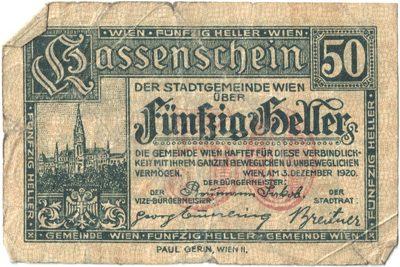
50 Heller, Stadtgemeinde Wien, 1920
Kassenschein der Stadtgemeinde Wien ueber 50 Heller
What was happening
Austria in 1919 was a republic of six and a half million people left holding the currency of an empire of fifty. The Austro-Hungarian Bank was in liquidation, the peace treaties had cut the country off from most of its coal and much of its food, and small coin simply vanished: hoarded against worse to come, melted for the metal, or carried across the new frontiers where it bought more. Shops could not give change, and a country that cannot give change cannot trade.
So the communes printed their own. A council resolution, a local printer, a redemption date and the pledge of the commune's entire movable and immovable property - that was the whole legal apparatus behind several thousand separate issues of Heller notes between 1919 and 1921. Vienna tolerated it while it solved a real problem and moved to stop it in 1920, by which time the notes had found a second market: collectors would pay more than face value for a complete set, so a village could raise real money by printing money it hoped would never be presented. The artwork improved as the need receded.
Vienna did it too, and at a scale that puts the villages in perspective: five million Kronen of fifty-Heller notes on this tranche, dated 3 December 1920, redeemable through the whole of December 1921.
Read the three signatures and you have the politics of the decade in one line. Jakob Reumann was Vienna's first Social Democratic mayor, elected in 1919 when the city separated from Lower Austria and became a province in its own right - which is why a municipal note carries a province's weight. Georg Emmerling was his deputy. And the third name is Hugo Breitner, the finance councillor who funded Red Vienna's housing programme with the steeply progressive municipal taxes his opponents called the Breitner taxes, and who was driven out of the country in 1934.
The note this trio signed is a fifty-Heller piece of small change, issued because the city could not otherwise let its citizens buy bread in the right quantities. Both facts are true at once, and neither is the whole story of Vienna in 1920.