Types / 1992
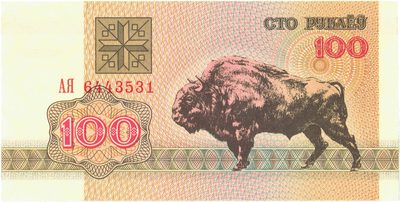
100 Rublei, National Bank of Belarus, 1992
Сто рублёў
What was happening
In May 1992 the newly independent Republic of Belarus issued its first national paper money, a set of small "settlement vouchers of the National Bank" that at first circulated alongside the Russian rouble. Because every denomination carried a different animal, Belarusians nicknamed the whole family the zaychiki ("little hares") after the leaping hare on the one-rouble note. This 100-rouble note was the top value of that first set, and it carries the European bison, the zubr.
The zubr of the Belavezhskaya Pushcha forest is Europe's largest land mammal and a standing emblem of Belarus; it dominates the face of the note above a spray of oak. The back carries the Pahonia, the galloping armoured horseman that served as the state coat of arms of the Republic from 1991 until the 1995 referendum replaced it with Soviet-style emblems. The notes therefore preserve a short-lived chapter of early-independence national symbolism.
Hyperinflation quickly overtook the series: denominations soon ran into the thousands and tens of thousands, and the whole family was demonetised at the end of 2000, when three zeros were struck from the currency. The notes are dated only "1992," bear no officials' signatures, and were printed by Goznak in Moscow.