Types / 1991
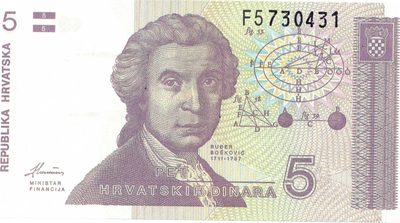
5 Dinara, Republika Hrvatska, 1991
Pet hrvatskih dinara
What was happening
These small notes were the money of a country being born under fire. When Croatia declared independence in 1991 and the wars of the Yugoslav dissolution reached its soil, the republic needed a currency of its own to replace the Yugoslav dinar. The answer was a stopgap: the Croatian dinar, a transitional currency whose notes carry the heading REPUBLIKA HRVATSKA, the date 8 October 1991, and the single signature of the Minister of Finance (MINISTAR FINANCIJA), Jozo Martinović.
Produced quickly and domestically by the Zrinski printing house in Čakovec, the whole family — from this 5-dinar note up through the larger values — shares one design. The obverse carries the head of Ruđer Bošković (Ruggiero Boscovich, 1711–1787), the Ragusan-born physicist, astronomer and mathematician, set among geometric and optical diagrams drawn from his work; the reverse, printed vertically, shows Zagreb Cathedral. The notes bear a watermark but no metal security thread.
The Croatian dinar was always meant to be temporary. Runaway inflation hollowed out the low denominations, and in 1994 the dinar was retired in favour of the kuna at a rate of 1,000 dinars to one kuna. These first notes survive mostly unspent, a quiet record of the improvised finances of a new state.