Types / 1921
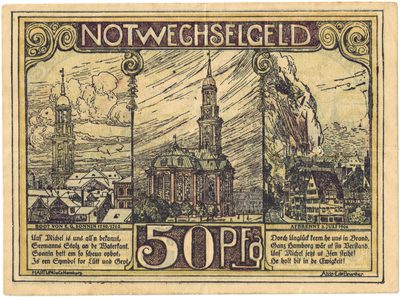
50 Pfennig, Hamburg, 1921 (St. Michaelis)
Notwechselgeld
What was happening
Notgeld began in 1914 out of necessity: coin vanished into hoards within weeks of mobilisation and towns printed their own small change because the Reichsbank could not supply enough.
By 1920 it had become something else. The shortage was easing but the collector market was not, and an issuer could take real marks for paper it hoped would never be presented. So towns, firms and clubs commissioned Serienscheine: lithographed sets, printed far beyond any local need, illustrated with whatever the place was proud of - a legend, a famous son, a battle, a trade, a joke in dialect. The result is the most inventive body of graphic design in the history of paper money, made in the years when Germany's currency was dying.
This is Notwechselgeld - emergency change money - issued at Hamburg in 1921 through the Hamburger Privatbank A.-G. von 1860, and void unless redeemed there by the end of the year. The set is Low German throughout: each note sets a verse in Platt against an old Hamburg scene, civic nostalgia doing the work of a watermark. The artist signed H. de Bruycker; the printer was Hartung & Co.
This 50-Pfennig note shows St. Michaelis - der Michel, Hamburg's Baroque landmark church - with a Low German verse recalling how the tower burned on 3 July 1906 and was rebuilt in iron; the harbour landing stages at St. Pauli are on the other face.