Types / 1961
10 Cents, Government of Hong Kong
香港政府
What was happening
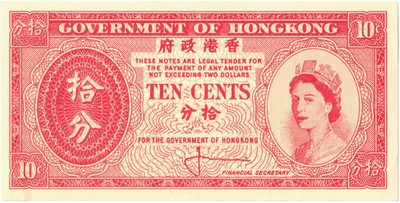
Hong Kong's paper money was, unusually, not the government's. Notes of one dollar and above were printed and issued by commercial banks - the Hongkong and Shanghai, the Chartered, the Mercantile - each with its own designs, all circulating side by side. But the small change below a dollar was the government's own, and these cent notes carry no bank's name at all: just GOVERNMENT OF HONG KONG, the sovereign's head, and the signature of the Financial Secretary.
They exist because of metal. Hong Kong first printed cent notes in 1941, when the approach of war made coin scarce, and returned to them whenever the price of the alloy or the supply of blanks made coins impractical. They were tiny, printed on one side, and worth so little that almost nobody kept them - which is why they survive mainly in the state they were saved in, unused and uncreased, rather than in the state they were spent in.
The legend on the face fixes their place exactly: legal tender for any amount not exceeding two dollars. A note that is money only in small quantities, issued by a government whose banknotes were somebody else's.
This is the 10-cent note, printed in red: the denomination in a guilloche rosette at the left, the legend in the centre, the Queen at the right, and 10c in each corner.