Types / 1921
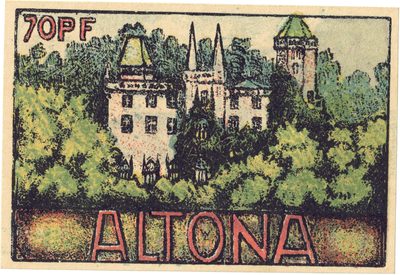
70 Pfennig, Stadt Altona, 1921
Notgeld der Stadt Altona
What was happening
Notgeld began in 1914 out of necessity: coin vanished into hoards within weeks of mobilisation and towns printed their own small change because the Reichsbank could not supply enough.
By 1920 it had become something else. The shortage was easing but the collector market was not, and a town could take real marks for paper it hoped would never be presented. So the municipalities commissioned Serienscheine: printed far beyond any local need and illustrated with whatever the place was proud of.
Altona sat on the Elbe immediately west of Hamburg — Danish until 1864, Prussian afterwards, and always Hamburg's close neighbour and commercial rival, until it was absorbed into Greater Hamburg in 1937/38. Its December 1921 emergency money is a single set of expressionist colour woodcuts, printed by the Altona firm H. W. Köbner & Co. and dated "Altona-E., 12. Dezember 1921". Every value shares a reverse — a stylised Gothic church cut in bold blocks of colour, carrying the serial, the Magistrat's facsimile signatures, the date and the warning that the note falls due two weeks after it is called in through the Altonaer Amts-Blatt. The obverses differ by denomination, each a woodcut view of the harbour city.
This seventy-Pfennig note turns away from the water to the leafy side of Altona — villas and towers among trees, the townscape of its wealthier streets, cut in soft colour against the harbour scenes of the lower values. Companion notes in the set are [[notgeld-altona-30-pfennig]], [[notgeld-altona-40-pfennig]], [[notgeld-altona-20-pfennig]], [[notgeld-altona-60-pfennig]] and [[notgeld-altona-80-pfennig]].