Types / 1921
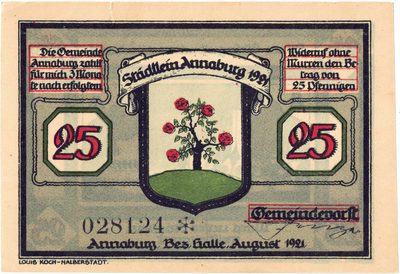
25 Pfennig, Stadt Annaburg, 1921 (stoneware)
Notgeld des Städtleins Annaburg
What was happening
Notgeld - "emergency money" - began in 1914 when metal coin vanished into hoards and towns printed their own small change. By 1920 it had become a collector's craze: municipalities commissioned Serienscheine, lithographed sets printed far beyond any local need and illustrated with local legends, industries and jokes in dialect, taking real marks for paper they hoped would never be redeemed.
Annaburg lies in the Elbe lowlands of what was then the Prussian Province of Saxony, today Saxony-Anhalt. Beyond its Renaissance castle and former military orphanage, the town owed its prosperity to a single industry: the Annaburger Steingutfabrik, a stoneware and earthenware works founded in 1874 and reorganised as the Annaburger Steingutfabrik AG in 1895. By the early 1900s it employed hundreds of people and carried the little town's name onto tableware sold across Germany.
The 1921 Serienschein shares a common front (the fruit-tree arms, Städtlein Annaburg 1921, red numerals, the parish redemption promise and a six-digit serial) and a different silhouette scene on each back. This 25-pfennig note turns the town's pride into a still life: an arrangement of stoneware vessels beside an ox-skull, captioned Durch Steingutsachen allerhand ward unser Städtlein weltbekannt - "through stoneware of every kind our little town became known the world over." Its sibling scenes in the collection are the castle note [[notgeld-annaburg-25-pfennig-schloss]] and the forest note [[notgeld-annaburg-25-pfennig-wald]].