Types / 1921
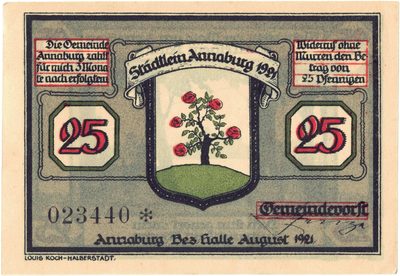
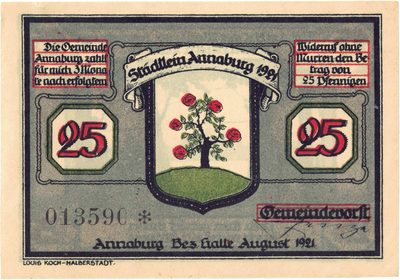
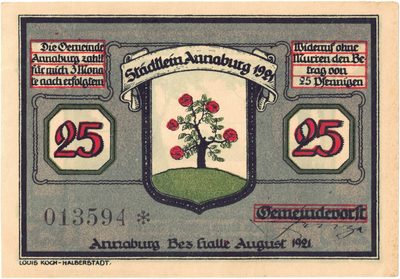
25 Pfennig, Stadt Annaburg, 1921 (forest)
Notgeld des Städtleins Annaburg
What was happening
Notgeld - "emergency money" - began in 1914 when metal coin vanished into hoards within weeks of mobilisation and towns printed their own small change. By 1920 it had become a collector's craze: municipalities commissioned Serienscheine, lithographed sets printed far beyond any local need and illustrated with local legends, landmarks and jokes in dialect, taking real marks for paper they hoped would never be redeemed.
Annaburg is a small town in the Elbe lowlands of what was then the Prussian Province of Saxony, today Saxony-Anhalt. It grew around an electoral Saxon hunting seat known as Lochau; the Renaissance castle there was rebuilt in the 1570s for the Elector August and his wife Anna of Denmark, and the town took her name. The surrounding Annaburger Heide - the Lochau heath where the Electors once hunted - was state forest, and that ownership is exactly the joke of this note.
The 1921 series shares a common front (the fruit-tree arms, Städtlein Annaburg 1921, red numerals, the parish redemption promise and a six-digit serial) and a different silhouette scene on each back. This 25-pfennig note shows tall forest trees standing by water, captioned Wohl steht der Wald um Annaburg gleich einem Stamm, doch ihm gehört darin auch nicht ein Stamm - a pun on Stamm: "the forest stands round Annaburg like one whole trunk (a close community), yet not a single trunk in it belongs to him" - the townsman surrounded by woods he may not cut, because the forest was Crown land. Its sibling scenes in the collection are the castle note [[notgeld-annaburg-25-pfennig-schloss]] and the stoneware note [[notgeld-annaburg-25-pfennig-steingut]].