Types / 1921
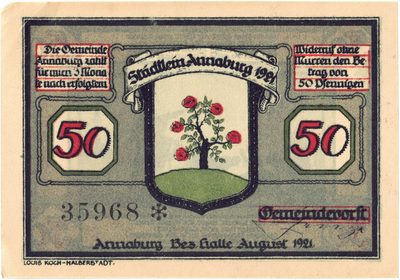
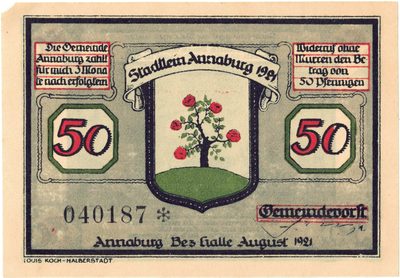
50 Pfennig, Stadt Annaburg, 1921 (lantern)
Notgeld des Städtleins Annaburg
What was happening
Notgeld - "emergency money" - began in 1914 when metal coin vanished into hoards and towns printed their own small change. By 1920 it had become a collector's craze: municipalities commissioned Serienscheine, lithographed sets printed far beyond local need and illustrated with legends, landmarks and jokes in dialect, sold to collectors for real marks the town hoped never to repay.
Annaburg is a small town in the Elbe lowlands of the former Prussian Province of Saxony, today Saxony-Anhalt. It grew up around the electoral hunting seat of Lochau, whose Renaissance castle was rebuilt in the 1570s for the Elector August and his wife Anna of Denmark; the town took her name. The 1921 series dresses everyday scenes from the little town in black silhouette.
The six notes share a front (fruit-tree arms, Städtlein Annaburg 1921, red numerals, parish redemption promise, serial) and differ only in the picture and verse on the back. This 50-pfennig note shows a night street scene lit by a lamp or lantern, with figures gathered beneath it and a four-line verse beside them. As on the rest of the set the verse is a small domestic or civic joke about life in Annaburg after dark; the exact wording is read off the Fraktur and is not independently attested. Its companions among the 50-pfennig notes in the collection are the tavern note [[notgeld-annaburg-50-pfennig-wirtschaft]] and the "cares and liqueur" note [[notgeld-annaburg-50-pfennig-sorgen]], with the 25-pfennig scenes [[notgeld-annaburg-25-pfennig-schloss]], [[notgeld-annaburg-25-pfennig-wald]] and [[notgeld-annaburg-25-pfennig-steingut]].