Types / 1921
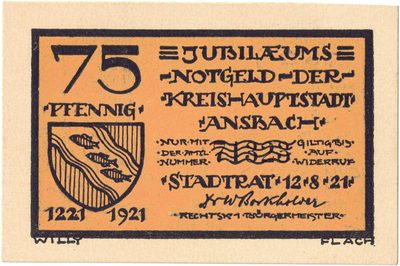
75 Pfennig, Stadt Ansbach, Bernadotte
Jubilaeums-Notgeld der Kreishauptstadt Ansbach
What was happening
Notgeld began in 1914 as necessity: silver and nickel coin vanished into hoards within weeks of mobilisation, and towns printed their own small change because the Reichsbank could not supply enough.
By 1920 it had become something else entirely. The shortage was easing, but the market for the notes was not - collectors would pay well above face value for a complete set, and a town could take real marks for paper it hoped would never come back to be redeemed. So the municipalities commissioned Serienscheine: lithographed series, four or six or ten notes to a set, printed far beyond any local need and illustrated with whatever the place was proud of. Local legends, famous sons, battles, saints, jokes in dialect.
The result is the most inventive body of graphic design in the history of paper money, made by places with a few thousand inhabitants, in the years when Germany's currency was dying.
Ansbach was the residence of the Franconian branch of the Hohenzollerns - margraves who ruled here from 1331 until the principality was sold to Prussia in 1791, and whose family went on to become kings of Prussia and emperors of Germany. In 1921 the town marked the seven hundredth anniversary of its first documentary mention, in 1221, and paid for the celebration in the way every German town did that year: by printing money.
The set is a history lesson in silhouette. Six scenes, cut as black paper-cuts against flat green or orange, each captioned with a year and a title, running from the charter of 1221 to Bernadotte's troops in 1805. The front is the same on every note - the town arms of three fish on a bend, the dates 1221 and 1921, and the signature of the legally qualified first mayor, dated 12 August 1921. The denomination changes the colour; the scene changes the note.
Two artists signed it, "Willy" at the lower left and "Flach" at the lower right.
This note carries the 1805 scene, printed in orange: a French grenadier striding past a broken frontier barrier with the town's spires behind him: Bernadotte's corps crossing neutral Ansbach in 1805 on its way to Austerlitz.