Types / 1920
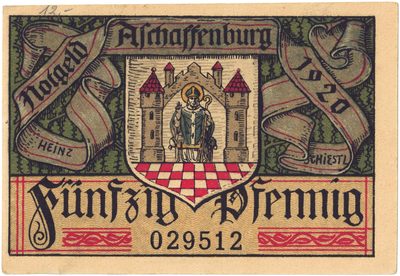
50 Pfennig, Stadt Aschaffenburg, 1920
Notgeld der Stadt Aschaffenburg ueber Fuenfzig Pfennig
What was happening
Notgeld - "emergency money". German towns, districts and firms began printing their own small change in 1914, when silver and nickel coin disappeared into hoards within weeks of mobilisation, and did not really stop until the stabilisation of 1923.
What began as necessity turned into a craze. By 1920 municipalities were commissioning Serienscheine: lithographed sets aimed squarely at collectors, printed far beyond any local need, illustrated with local legends, landmarks, famous sons and jokes in dialect. Selling them was itself a way of raising money - the town took real marks for notes it hoped would never be presented for redemption. The result is the most inventive body of graphic design in the history of paper money, produced by places with a few thousand inhabitants.
Aschaffenburg sits on the Main at the edge of the Spessart forest. For six hundred years it belonged not to Bavaria but to the Archbishop-Electors of Mainz, who kept a residence here; it passed to Bavaria only in 1814. Both facts are on its money. The shield with the six-spoked red wheel is Mainz; the blue and white lozenges are Bavaria; and the bishop who holds or sits between them is St. Martin, patron of the Mainz see and of Aschaffenburg's collegiate church.
The town issued a set of Serienscheine in 1920, numbered, valid bis auf Widerruf - until revoked - over the signature of the mayor Dr. Wilhelm Matt. They were drawn by Heinz and Schiestl and printed by Stuertz in Wuerzburg, and between them they work through everything the town had to be proud of: its two allegiances, the forest it sits against, and the painter who worked here.
The fifty is the one with the portrait. Its reverse shows a bearded man in profile against a green ground, with the monogram MG below him: Matthias Gruenewald, who painted the Isenheim altarpiece and who worked at Aschaffenburg as court painter and architect to the Archbishops of Mainz, and is buried in the town.
He was almost entirely forgotten for three hundred years and rediscovered around 1900, when the Expressionists took him up; by 1920, when this note was printed, Gruenewald had become one of the most talked-about painters in Germany. A town that could claim him was not going to miss the chance.
The face keeps to the civic formula: St. Martin between two towers over the quartered shield of wheel and lozenges, with 1920 on a ribbon and the serial number below.