Types / 1921
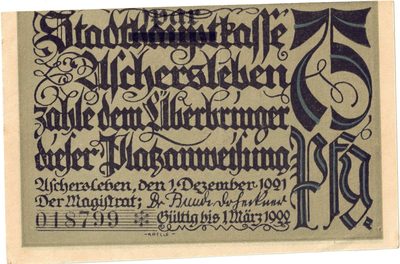
75 Pfennig, Stadt Aschersleben, 1921
Stadthauptkasse Aschersleben
What was happening
Notgeld began in 1914 out of necessity: coin vanished into hoards within weeks of mobilisation and towns printed their own small change because the Reichsbank could not supply enough.
By 1920 it had become something else. The shortage was easing but the collector market was not, and a town could take real marks for paper it hoped would never be presented. So the municipalities commissioned Serienscheine: lithographed sets illustrated with whatever the place was proud of. The result is the most inventive body of graphic design in the history of paper money, made in the years when Germany's currency was dying.
Aschersleben, on the northern edge of the Harz, claims to be the oldest town in what is now Saxony-Anhalt: it is first mentioned in 753, and the Latin name of its castle, Ascharia, gave its name to the house of Ascania. It held town rights by 1266 and the right to a walled circuit of defensive towers by 1322.
This note was put out by the Stadthauptkasse, the municipal treasury, dated 1 December 1921 and valid to 1 March 1922 - late enough in the inflation that it reads more as a redemption voucher than everyday change. The face is heavy Fraktur: the treasury's pledge to pay the bearer of the Platzanweisung, over a large ornate value and a serial, signed by the Magistrat. The reverse is a dark allegorical and industrial scene with figures.