Types / 1921
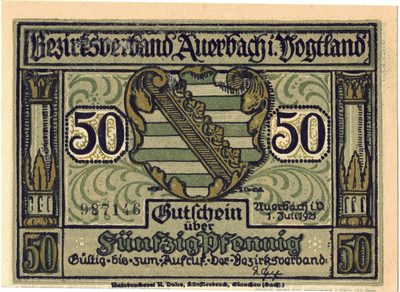
50 Pfennig, District of Auerbach im Vogtland, 1921
Gutschein des Bezirksverbandes Auerbach i. Vogtland
What was happening
Notgeld began in 1914 out of necessity: coin vanished into hoards within weeks of mobilisation and towns printed their own small change because the Reichsbank could not supply enough.
By 1920 it had become something else. The shortage was easing but the collector market was not, and a town could take real marks for paper it hoped would never be presented. So the municipalities commissioned Serienscheine: lithographed sets, printed far beyond any local need, illustrated with whatever the place was proud of - a legend, a famous son, a battle, a joke in dialect. The result is the most inventive body of graphic design in the history of paper money, made by places with a few thousand inhabitants, in the years when Germany's currency was dying.
The district of Auerbach in the Vogtland issued a numbered set in July 1921, cut as silhouettes by Hans Kinder and printed by the council press at Glauchau. The scenes are numbered and run a story about a gluttonous bailiff who goes looking for a dish of a rarer kind: Der Landvogt war ein Schlemmerbart, sucht ein Gericht gar seltner Art.