Types / 1921
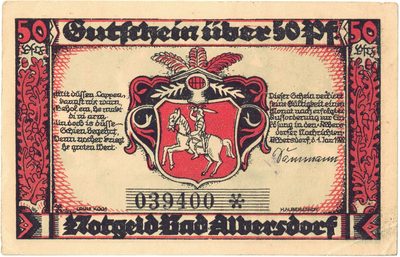
50 Pfennig, Bad Albersdorf, 1921
Notgeld Bad Albersdorf
What was happening
By 1920 German Notgeld had stopped being a response to a coin shortage and become a collector's product. Towns, districts and firms commissioned decorative Serienscheine - lithographed sets printed far beyond any local need and sold to collectors, illustrated with whatever the place was proud of: a legend, a famous son, a battle, a trade, a joke in dialect. The result is the most inventive body of graphic design in the history of paper money, made in the years when Germany's currency was dying.
Albersdorf, a health resort in Dithmarschen in western Holstein, sits in a landscape unusually rich in Neolithic megalithic tombs - the Dithmarschen "Huenengraeber," of which the Brutkamp dolmen nearby is the best known. The note turns one of them into an Altgermanischer Opferaltar, an "ancient Germanic sacrificial altar," the sort of prehistoric-national imagery that German Notgeld reached for again and again. Printed by Louis Koch of Halberstadt, serial 039400.