Types / 1921
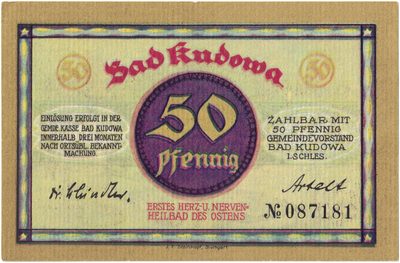
50 Pfennig, Bad Kudowa in Schlesien, 1921
Notgeld Bad Kudowa
What was happening
Notgeld - "emergency money" - began in 1914 when metal coin vanished and towns printed their own small change. By 1921 it had become a collector's craze, and even small resort towns commissioned illustrated notes that advertised themselves: the picture and the slogan were as much the point as the value.
Bad Kudowa (today Kudowa-Zdrój, in Poland) lies in the far south-west of what was then Prussian Lower Silesia, in the Glatzer Bergland close to the Bohemian border - a mineral-spring spa whose iron-and-arsenic waters drew visitors for heart and nerve cures. Until 1945 it was a German town; it passed to Poland after the Second World War, with the German population expelled and the place renamed. This note is a relic of its German spa era.
The 50-Pfennig note, issued about 1921 by the communal treasury (Gem. Kasse Bad Kudowa) and signed by Artelt, reads like an advertisement. The face proclaims Bad Kudowa the "Erstes Herz- u. Nerven-Heilbad des Ostens" - the first heart-and-nerve spa of the East - with the value and the serial number. The reverse shows the spa park and the mottoes "Gesundheit ist Reichtum" (health is wealth) and a boast for the Eugenquelle as the "stärkste Eisen-Arsenquelle Deutschlands", the strongest iron-arsenic spring in Germany.