Types / 1921
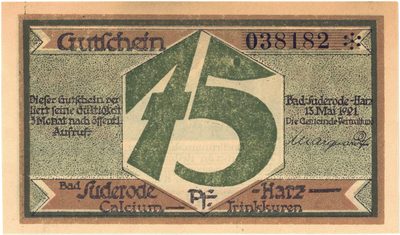
75 Pfennig, Bad Suderode, 1921 (spa)
Bad Suderode-Harz
What was happening
Notgeld began in 1914 out of necessity: coin vanished into hoards within weeks of mobilisation and towns printed their own small change because the Reichsbank could not supply enough.
By 1920 it had become something else. The shortage was easing but the collector market was not, and an issuer could take real marks for paper it hoped would never be presented. So towns, firms and clubs commissioned Serienscheine: lithographed sets, printed far beyond any local need, illustrated with whatever the place was proud of - a legend, a famous son, a battle, a trade, a joke in dialect. The result is the most inventive body of graphic design in the history of paper money, made in the years when Germany's currency was dying.
Bad Suderode is a small spa in the eastern Harz, now part of Quedlinburg. A brine spring found in 1827 turned the village into a Kurbad, and it was granted the title 'Bad' in 1914; its Behringer Brunnen is one of the strongest calcium brines in Europe, taken as drinking cures and baths.
The note advertises exactly that - Calcium - Trinkkuren - and sets on the back a spring nymph in a wooded park, the gentle guardian of the healing waters, under a verse that has kindly spring-nymphs lending the place its power to heal. Issued 13 May 1921.