Types / 1921
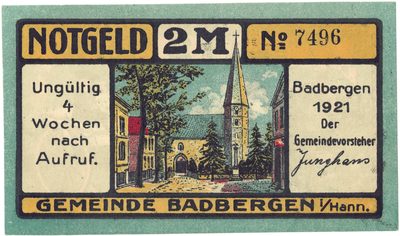
2 Mark, Gemeinde Badbergen, 1921
Gemeinde Badbergen i/Hann.
What was happening
Notgeld began in 1914 out of necessity: coin vanished into hoards within weeks of mobilisation and towns printed their own small change because the Reichsbank could not supply enough.
By 1920 it had become something else. The shortage was easing but the collector market was not, and a town could take real marks for paper it hoped would never be presented. So the municipalities commissioned Serienscheine: lithographed sets, printed far beyond any local need, illustrated with whatever the place was proud of - a legend, a famous son, a battle, a joke in dialect. The result is the most inventive body of graphic design in the history of paper money, made in the years when Germany's currency was dying.
Badbergen sits in the Artland, the fertile farming district north-east of Osnabrück in what was then the Prussian Province of Hanover (hence i/Hann. on the face) and is today Lower Saxony. The Artland - the parishes of Badbergen, Gehrde and Menslage with the town of Quakenbrück - grew wealthy on good soil, and that wealth left two things the region is still known for: hundreds of monumental half-timbered farmhouses, and a prosperous landed farmer class with a festival dress of its own. Badbergen's 1921 notes celebrate both.
This two-mark note - the largest of the set - shows a church and town-gate scene on the front and, on the back, a horse-drawn cart carrying figures in Artland dress, the folk costume of the district (Alte Artländer Trachten). The note is dated "Badbergen 1921" and belongs with the parish's other issues; see the companion note [[notgeld-badbergen-25-pfennig]], which shows the church of St. Georg.