Types / 1920
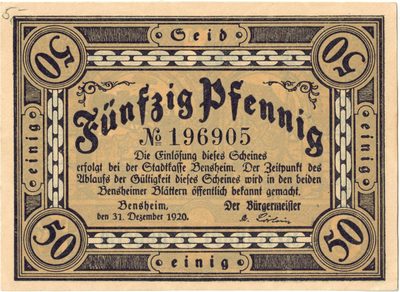
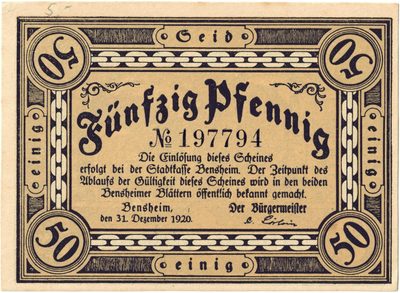
50 Pfennig, Kreisstadt Bensheim, 1920
Gutschein der Kreisstadt Bensheim ueber Fuenfzig Pfennig
What was happening
Notgeld - "emergency money". German towns, districts and firms began printing their own small change in 1914, when silver and nickel coin disappeared into hoards within weeks of mobilisation, and did not really stop until the stabilisation of 1923.
What began as necessity turned into a craze. By 1920 municipalities were commissioning Serienscheine: lithographed sets aimed squarely at collectors, printed far beyond any local need, illustrated with local legends, landmarks, famous sons and jokes in dialect. Selling them was itself a way of raising money - the town took real marks for notes it hoped would never be presented for redemption. The result is the most inventive body of graphic design in the history of paper money, produced by places with a few thousand inhabitants.
Bensheim stands on the Bergstrasse in southern Hesse, at the foot of the Odenwald. Its note is dated 31 December 1920, numbered, and the redemption date was to be published in the two Bensheim newspapers - a promise to announce a promise.
The design turns on a pair of dates. Two arches side by side on the reverse are labelled 1320 and 1920: under the first, a knight in plate at a town gate; under the second, a motor car and a railway locomotive in front of the same town. Bensheim received its town rights in 1320, and in 1920, six hundred years later and in the middle of a currency collapse, it marked the anniversary on its emergency money.
Two copies are held, with consecutive-range serial numbers from the same printing.