Types / 1919
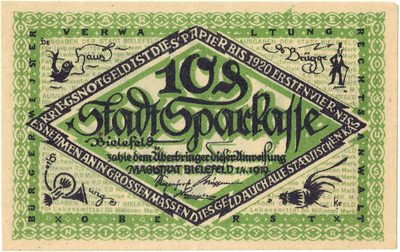
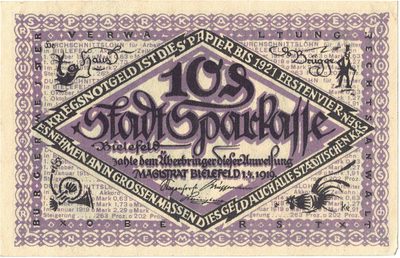
10 Pfennig, Stadt-Sparkasse Bielefeld, 1919
Stadt-Sparkasse Bielefeld
What was happening
Notgeld began in 1914 out of necessity: coin vanished into hoards within weeks of mobilisation and towns printed their own small change because the Reichsbank could not supply enough. The small-change notes (Kleingeldscheine) issued by town treasuries and municipal savings banks were the plain working end of the phenomenon, printed to pass from hand to hand rather than into an album.
This is one of them: a 10-Pfennig note of the Stadt-Sparkasse Bielefeld, the municipal savings bank of the Westphalian linen town, dated "Magistrat Bielefeld, 1. April 1919." It promises to pay the bearer of the draft on demand. Bielefeld became one of the most prolific and celebrated of all Notgeld issuers - later famous for its linen and silk Stoffgeld, the cloth money of the 1921 jubilee (see [[notgeld-bielefeld-25-mark-stoffgeld]]) - but these early small-change notes were ordinary municipal currency.
The obverse is built around a large diamond carrying the value "10 ₰" and the Stadt-Sparkasse legend, bordered with figures and corner vignettes; the reverse carries an ornamental oak-leaf and acorn design. It was issued in several colour variants, which this type covers.