Types / 1920
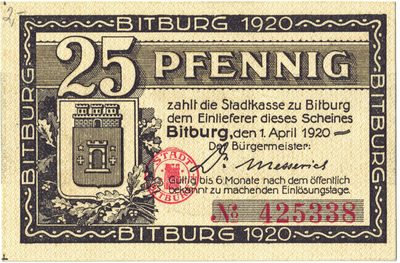
25 Pfennig, Stadt Bitburg, 1920
Stadt Bitburg - 25 Pfennig
What was happening
Notgeld - "emergency money". German towns, districts and firms began printing their own small change in 1914, when silver and nickel coin disappeared into hoards within weeks of mobilisation, and did not really stop until the stabilisation of 1923.
What began as necessity turned into a craze. By 1920 municipalities were commissioning Serienscheine: lithographed sets aimed squarely at collectors, printed far beyond any local need, illustrated with local legends, landmarks, famous sons and jokes in dialect. Selling them was itself a way of raising money - the town took real marks for notes it hoped would never be presented for redemption. The result is the most inventive body of graphic design in the history of paper money, produced by places with a few thousand inhabitants.
Bitburg is in the Eifel, in the western Rhineland - which in April 1920, when this note is dated, meant occupied territory. The Rhineland west of the river was held by Allied troops under the Versailles settlement, and the Eifel lay in the French zone.
The note is numbered, signed by the mayor Messerich, struck with a red Stadt Bitburg cachet across the face, and valid until six months after a redemption day still to be announced. The face shows the town gate in a shield with oak leaves; the reverse, a church and a round tower above the roofs.
It is a plain, almost severe piece of design - black on cream with one red overprint - and that restraint is itself worth noting. Notgeld from occupied towns tends not to be playful.