Types / 1919
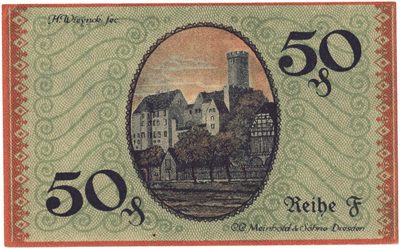
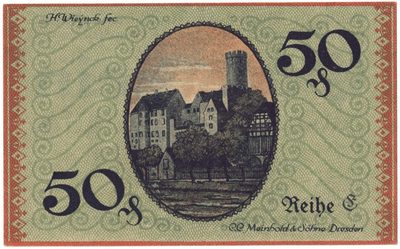
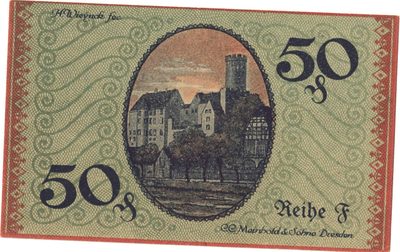
50 Pfennig, District of Borna, 1919
Gutschein des Bezirksverbandes der Amtshauptmannschaft Borna
What was happening
Notgeld - "emergency money". German towns, districts and firms began printing their own small change in 1914, when silver and nickel coin disappeared into hoards within weeks of mobilisation, and did not really stop until the stabilisation of 1923.
What began as necessity turned into a craze. By 1920 municipalities were commissioning Serienscheine: lithographed sets aimed squarely at collectors, printed far beyond any local need, illustrated with local legends, landmarks, famous sons and jokes in dialect. Selling them was itself a way of raising money - the town took real marks for notes it hoped would never be presented for redemption. The result is the most inventive body of graphic design in the history of paper money, produced by places with a few thousand inhabitants.
Borna is a district town south of Leipzig, at the heart of the Saxon brown-coal field. This note is not the town's but the district association's - the Bezirksverband der Amtshauptmannschaft Borna - valid throughout the district until the last day of 1919.
It was issued in lettered series, and the collection holds two: Reihe E and Reihe F. The design is the same in both, a pale green field with a woodcut of a castle and half-timbered houses under a tower in an oval at the centre, signed by the artist H. Weyneck and printed by Meinhold of Dresden - one of the large Saxon houses, which is why the register is clean and the tint work is better than a district office needed.