Types / 1921
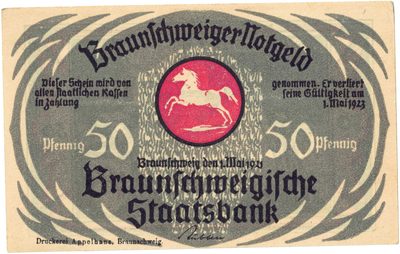
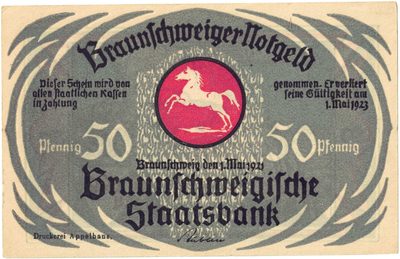
50 Pfennig, Braunschweig State Bank, 1921
Braunschweiger Notgeld - Braunschweigische Staatsbank
What was happening
Notgeld began in 1914 as necessity: silver and nickel coin vanished into hoards within weeks of mobilisation, and towns printed their own small change because the Reichsbank could not supply enough.
By 1920 it had become something else entirely. The shortage was easing, but the market for the notes was not - collectors would pay well above face value for a complete set, and a town could take real marks for paper it hoped would never come back to be redeemed. So the municipalities commissioned Serienscheine: lithographed series, four or six or ten notes to a set, printed far beyond any local need and illustrated with whatever the place was proud of. Local legends, famous sons, battles, saints, jokes in dialect.
The result is the most inventive body of graphic design in the history of paper money, made by places with a few thousand inhabitants, in the years when Germany's currency was dying.
Braunschweig's set is the largest in this collection and the only one issued by a state bank rather than a town hall: the Braunschweigische Staatsbank, for the Free State of Brunswick, all dated 1 May 1921 and all lapsing 1 May 1923.
The face is the same throughout - the white horse of Saxony rearing in a coloured panel, the denomination either side, blackletter across the top - and the colour changes with the value. The reverses divide into two quite different halves. One runs on Till Eulenspiegel, the trickster of the late-medieval jest books, who was born at Kneitlingen a few miles from Braunschweig and who is the region's defining folk figure; those notes carry Low German verse and a scene from one of his tales. The other half is topographical: Blankenburg, the Regenstein, the Altstadtmarkt, places in the duchy that people might want to visit again.
Printed by Appelhans of Braunschweig; the Eulenspiegel designs are signed Günther Clausen.
This note is the 50 Pfennig in grey and red. Its reverse shows the ruined castle of the Regenstein rising out of its sandstone crag above Blankenburg, signed Thulesius.