Types / 1921
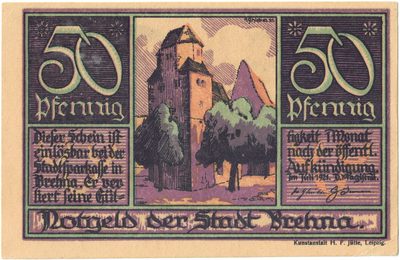
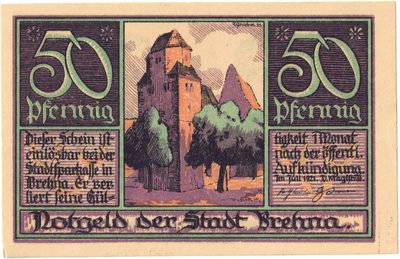
50 Pfennig, Stadt Brehna, 1921
Notgeld der Stadt Brehna
What was happening
Notgeld began in 1914 as necessity: silver and nickel coin vanished into hoards within weeks of mobilisation, and towns printed their own small change because the Reichsbank could not supply enough.
By 1920 it had become something else entirely. The shortage was easing, but the market for the notes was not - collectors would pay well above face value for a complete set, and a town could take real marks for paper it hoped would never come back to be redeemed. So the municipalities commissioned Serienscheine: lithographed series, four or six or ten notes to a set, printed far beyond any local need and illustrated with whatever the place was proud of. Local legends, famous sons, battles, saints, jokes in dialect.
The result is the most inventive body of graphic design in the history of paper money, made by places with a few thousand inhabitants, in the years when Germany's currency was dying.
Brehna is a very small town between Halle and Bitterfeld, and it has one claim on history: Katharina von Bora was schooled at the Benedictine convent here as a child, for about four years from 1504, before she was moved to Nimbschen, escaped in a herring barrel, and married Martin Luther.
The town put the two of them side by side on its fifty-Pfennig note, with a verse of Luther's on the raising of children either side and a view of Brehna below. The twenty-five carries the arms of the old county of Brehna and the note that it once comprised sixteen villages - a place recording, on emergency money in 1921, that it used to matter more than it does.
This is the 50 Pfennig; its reverse shows portraits of Dr. Martin Luther (1483–1546) and Katharina von Bora side by side above a view of Brehna, with a verse of Luther's on either side.