Types / 1921
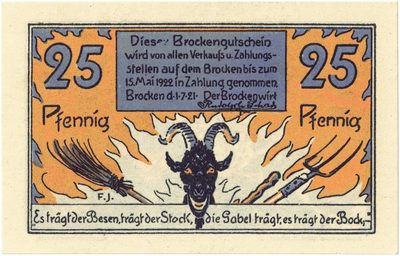
25 Pfennig, Brockengutschein, 1921
Brockengutschein - Der Brockenwirt
What was happening
Notgeld began in 1914 as necessity: silver and nickel coin vanished into hoards within weeks of mobilisation, and towns printed their own small change because the Reichsbank could not supply enough.
By 1920 it had become something else entirely. The shortage was easing, but the market for the notes was not - collectors would pay well above face value for a complete set, and an issuer could take real marks for paper it hoped would never come back to be redeemed. So towns, districts and private issuers commissioned Serienscheine: lithographed series illustrated with whatever the place was proud of. The result is the most inventive body of graphic design in the history of paper money, made in the years when Germany's currency was dying.
The oddest issuer in the collection is not a town, not a district, not a company, but the landlord of the inn on top of a mountain. The Brocken is the highest peak of the Harz at 1,142 metres, and the Brockenwirt issued this voucher to be taken in payment at the sales and payment points on the summit; it is dated "Brocken, 1.7.1921" and valid until 15 May 1922. This 25-Pfennig value belongs to the souvenir set designed by the illustrator Franz Jüttner and sold to walkers to carry down.
Both faces are the mountain's witch-legend. The obverse shows the Brocken goat with broom, pitchfork and sabre, over the voucher text "Dieser Brockengutschein ... auf dem Brocken ..."; the reverse is the Walpurgisnacht itself, the witches riding up to the summit. Goethe (1749-1832) set the witches' sabbath of Faust on this mountain, and the Harz has traded on it ever since. The collection already holds the [[notgeld-brocken-50-pfennig]] and the [[notgeld-brocken-75-pfennig]] of the same set.