Types / 1921
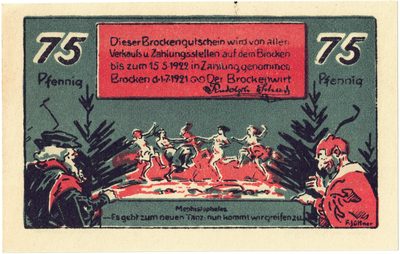
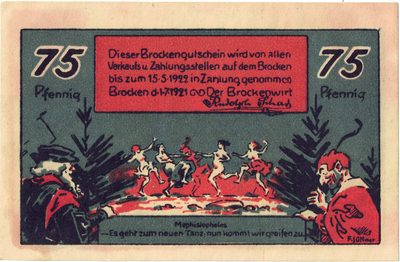
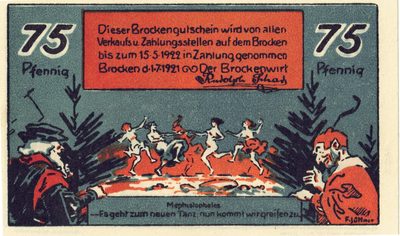
75 Pfennig, Brockengutschein, 1921
Brockengutschein - Der Brockenwirt
What was happening
Notgeld began in 1914 as necessity: silver and nickel coin vanished into hoards within weeks of mobilisation, and towns printed their own small change because the Reichsbank could not supply enough.
By 1920 it had become something else entirely. The shortage was easing, but the market for the notes was not - collectors would pay well above face value for a complete set, and a town could take real marks for paper it hoped would never come back to be redeemed. So the municipalities commissioned Serienscheine: lithographed series, four or six or ten notes to a set, printed far beyond any local need and illustrated with whatever the place was proud of. Local legends, famous sons, battles, saints, jokes in dialect.
The result is the most inventive body of graphic design in the history of paper money, made by places with a few thousand inhabitants, in the years when Germany's currency was dying.
The oddest issuer in the collection: not a town, not a district, not a company, but the landlord of the inn on top of a mountain. The Brocken is the highest peak of the Harz at 1,142 metres, and the Brockenwirt Rudolph Schade issued this voucher to be taken in payment at every sales and payment point on the summit until 15 May 1922.
Both faces are Walpurgisnacht. Goethe (1749–1832) set the witches' sabbath of Faust on this mountain, and the note illustrates it directly: Mephistopheles at the right of the face with a line of naked witches dancing away from him, and on the reverse the crowd of them streaming through the pines under four lines of Faust's own - Einst hab ich einen schönen Traum... da sah ich einen Apfelbaum.
A mountain inn printing Goethe on its own currency, for walkers to carry down as a souvenir.