Types / 1921
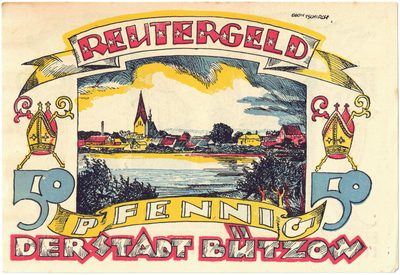
50 Pfennig, Stadt Buetzow, 1921
Reutergeld der Stadt Buetzow
What was happening
Notgeld began in 1914 as necessity: silver and nickel coin vanished into hoards within weeks of mobilisation, and towns printed their own small change because the Reichsbank could not supply enough.
By 1920 it had become something else entirely. The shortage was easing, but the market for the notes was not - collectors would pay well above face value for a complete set, and a town could take real marks for paper it hoped would never come back to be redeemed. So the municipalities commissioned Serienscheine: lithographed series, four or six or ten notes to a set, printed far beyond any local need and illustrated with whatever the place was proud of. Local legends, famous sons, battles, saints, jokes in dialect.
The result is the most inventive body of graphic design in the history of paper money, made by places with a few thousand inhabitants, in the years when Germany's currency was dying.
This is Reutergeld - Reuter money. In 1921 a group of Mecklenburg towns issued a joint series celebrating Fritz Reuter (1810-1874), the writer who made literature out of Low German and is to Mecklenburg what Burns is to Scotland. Each town took a scene and a line of his; Bützow took Uns' Herrgott helpt blot den, de sick sülwen helpt - Our Lord helps only those who help themselves.
Bützow was a bishop's residence and then the seat of Mecklenburg's short-lived university, which is why two mitres flank the denomination on the face. The drawing is by Egon Tschirch, a Rostock painter of the Mecklenburg secession.