Types / 1921
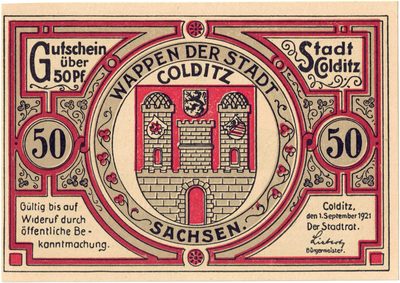
50 Pfennig, Stadt Colditz, 1921 (town hall)
Notgeld der Stadt Colditz
What was happening
Notgeld - "emergency money" - began in 1914 when metal coin vanished into hoards and German towns printed their own small change. By 1920 it had become a collector's craze: municipalities commissioned Serienscheine, lithographed sets printed far beyond local need and illustrated with the town's landmarks and legends, sold to collectors for real marks the town hoped never to repay.
Colditz is a Saxon town on the river Mulde between Leipzig and Chemnitz, grown up around 1200 beneath a castle first recorded in 1046. Its history was punctuated by fire - the Hussites burned town and castle in 1430, and a great fire in 1504 is recorded as destroying the town hall, church and much else - so its civic buildings are rebuildings, and the townspeople were proud of them.
The notes of the 1921 series share a cream-and-red front - Gutschein über 50 Pf, the Colditz castle-gate arms with their lion, Stadt Colditz Sachsen and the validity line Gültig bis auf Widerruf - and differ in the scene on the back. This note gives an oval view of the Colditz Rathaus, the Renaissance town hall; the note dates its building to about 1547-1550, a date carried on the note itself. Its siblings in the collection are the Swedish-war note [[notgeld-colditz-50-pfennig-schweden]], the Hussite note [[notgeld-colditz-50-pfennig-husiten]], the stoneware note [[notgeld-colditz-50-pfennig-steingut]], the tower note [[notgeld-colditz-50-pfennig-heimatturm]] and the Mulde-valley note [[notgeld-colditz-50-pfennig-muldental]].