Types / 1921
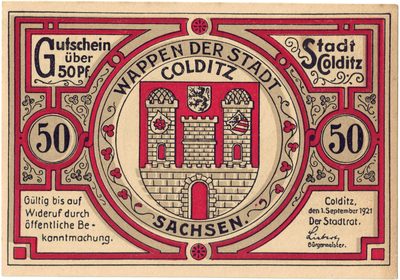
50 Pfennig, Stadt Colditz, 1921 (stoneware)
Notgeld der Stadt Colditz
What was happening
Notgeld - "emergency money" - began in 1914 when metal coin vanished into hoards and German towns printed their own small change. By 1920 it had become a collector's craze: municipalities commissioned Serienscheine, lithographed sets printed far beyond local need and illustrated with the town's legends, trades and landmarks, sold to collectors for real marks the town hoped never to repay.
Colditz is a Saxon town on the river Mulde between Leipzig and Chemnitz, below a Renaissance castle later infamous as the wartime prison Oflag IV-C. Rich deposits of kaolin and clay in the surrounding country gave the town an industry that long outlasted its castle's princely days: Colditz stoneware (Colditzer Steingut), a hard, everyday earthenware whose jugs, bowls and storage pots carried the town's name across Germany.
The notes of the 1921 series share a cream-and-red front - Gutschein über 50 Pf, the Colditz castle-gate arms with their lion, Stadt Colditz Sachsen and the validity line Gültig bis auf Widerruf - and differ in the scene on the back. This note celebrates the pottery trade, showing a potter at the wheel in the Colditz stoneware works, with a verse about the craft. Its siblings in the collection are the Swedish-war note [[notgeld-colditz-50-pfennig-schweden]], the Hussite note [[notgeld-colditz-50-pfennig-husiten]], the town-hall note [[notgeld-colditz-50-pfennig-rathaus]], the tower note [[notgeld-colditz-50-pfennig-heimatturm]] and the Mulde-valley note [[notgeld-colditz-50-pfennig-muldental]].