Types / 1920
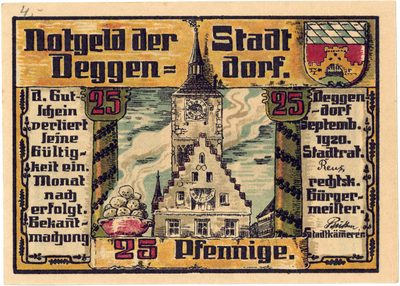
25 Pfennig, Stadt Deggendorf, 1920
Notgeld der Stadt Deggendorf
What was happening
Notgeld - "emergency money". German towns, districts and firms began printing their own small change in 1914, when silver and nickel coin disappeared into hoards within weeks of mobilisation, and did not really stop until the stabilisation of 1923.
What began as necessity turned into a craze. By 1920 municipalities were commissioning Serienscheine: lithographed sets aimed squarely at collectors, printed far beyond any local need, illustrated with local legends, landmarks, famous sons and jokes in dialect. Selling them was itself a way of raising money - the town took real marks for notes it hoped would never be presented for redemption. The result is the most inventive body of graphic design in the history of paper money, produced by places with a few thousand inhabitants.
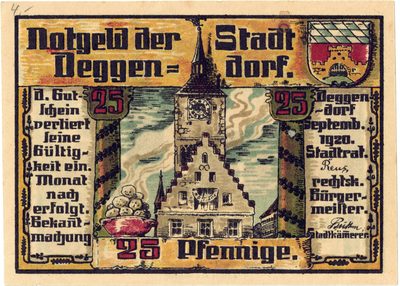
Deggendorf is a Danube town in Lower Bavaria, at the foot of the Bavarian Forest. Its twenty-five Pfennig note is dated September 1920, numbered, and lapses one month after the town announces the call - signed by the legally qualified mayor Reuss and the municipal treasurer.
Deggendorf's nickname is Knoedelstadt, the dumpling town, and the note takes it seriously. Beside the Gothic tower of the old town hall on the face sits a bowl heaped with dumplings, drawn at the same scale as the architecture. Two copies are held, from the same printing.
The reverse is an entirely different register: the town hall and the roofs of the old town against a burnt-orange evening sky, printed in four colours, with the arms of the town in the corner. For a twenty-five Pfennig note this is a lot of press work - which is the whole point of a Serienschein.