Types / 1921
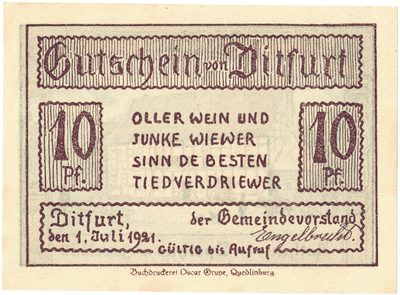
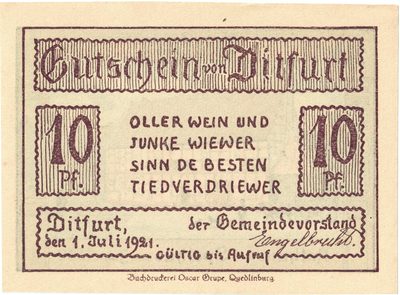
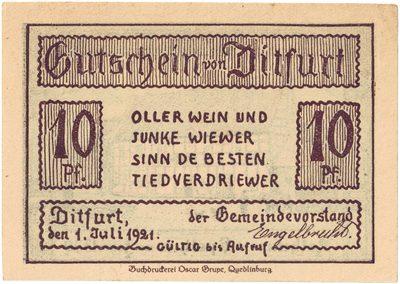
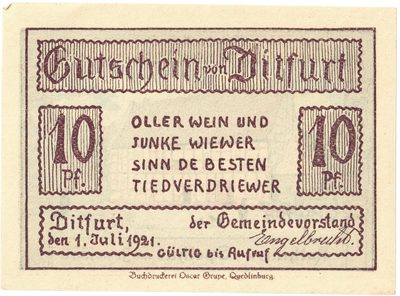
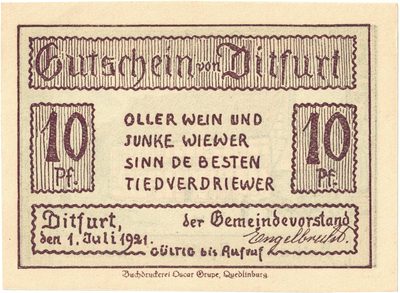
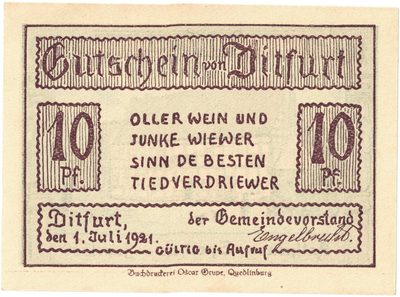
10 Pfennig, Gemeinde Ditfurt, 1921
Gutschein von Ditfurt
What was happening
Notgeld - "emergency money" - began in 1914 when metal coin vanished into hoards within weeks of mobilisation and the Reichsbank could not supply enough small change. Towns, districts and firms printed their own. By 1920 the shortage was easing but the craze was not: municipalities commissioned decorative Gutscheine and Serienscheine, lithographed far beyond any local need and sold to collectors, who paid real marks for paper the town hoped would never be redeemed.
Ditfurt is a village on the river Bode a few kilometres east of Quedlinburg, in what was then the Prussian Province of Saxony and is today Saxony-Anhalt. In 974 the village was among the royal estates made over to the imperial abbess of Quedlinburg, and its medieval dues to that abbey are the subject of the village's egg-tax series (see the siblings [[notgeld-ditfurt-50-pfennig-eier]] and [[notgeld-ditfurt-50-pfennig-steuertag]]). This note belongs to the other, plainer Ditfurt family: a Gutschein von Ditfurt with a Low-German motto on the face and a colour view of the village on the back.
The face carries the dialect couplet Oller Wein und junke Wiewer sinn de besten Tiedverdriewer - "old wine and young women are the best pastimes" - one of the broad village jokes that make the Ditfurt notes memorable. The back shows the half-timbered Rathaus und Spritzhaus ("town hall and fire-engine house") captioned as dating from the year 1550. The note is dated at Ditfurt, 1 July 1921, and signed by Engelbrecht, Gemeindevorstand (head of the parish council).