Types / 1921
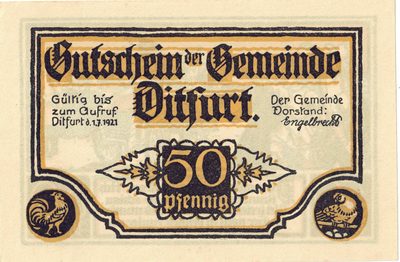
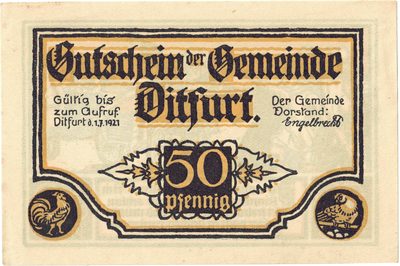
50 Pfennig, Gemeinde Ditfurt, 1921 (the peasant woman)
Gutschein der Gemeinde Ditfurt
What was happening
By 1920 German Notgeld had stopped being a response to a coin shortage and become a collector's product. Towns, districts and firms commissioned decorative Serienscheine - lithographed sets printed far beyond any local need and sold to collectors, illustrated with whatever the place was proud of: a legend, a famous son, a battle, a joke in dialect. The town took real marks for paper it hoped would never be presented.
Ditfurt is a village on the river Bode a few kilometres east of Quedlinburg, in what was then the Prussian Province of Saxony and is today Saxony-Anhalt. In 974 it was among the royal estates made over to the imperial abbess of Quedlinburg, and from that medieval lordship grew the comic tale the village chose for its 1921 series: the Ditfurt Eierzins, a render once owed to the abbey and paid in eggs. The set is a run of black-and-orange woodcut panels (signed "M.F.") telling the story in rhyming couplets, the villagers forever grumbling as they cart their eggs to the castle.
This note is panel 3. The back shows an ox-cart on the road, with a peasant woman voicing the complaint of the whole set - the verse begins Da sagte eine Bauersfrau: Ach Kinners... ("then a peasant woman said: oh children...") and turns on the eggs jolting down from both sides of the load. The face is the shared Gutschein der Gemeinde Ditfurt / 50 Pfennig with its rooster and hen vignettes. The companion panels held in the collection are [[notgeld-ditfurt-50-pfennig-adelheid]] (the origin of the tax), [[notgeld-ditfurt-50-pfennig-eier]] (the peasants at the castle gate) and [[notgeld-ditfurt-50-pfennig-steuertag]] (loading the cart on tax-day).