Types / 1921
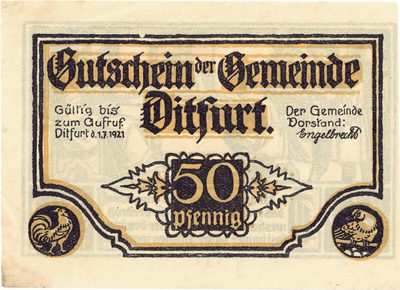
50 Pfennig, Gemeinde Ditfurt, 1921 (eggs to the castle)
Gutschein der Gemeinde Ditfurt
What was happening
Notgeld began in 1914 out of necessity: coin vanished into hoards within weeks of mobilisation and towns printed their own small change because the Reichsbank could not supply enough.
By 1920 it had become something else. The shortage was easing but the collector market was not, and a town could take real marks for paper it hoped would never be presented. So the municipalities commissioned Serienscheine: lithographed sets, printed far beyond any local need, illustrated with whatever the place was proud of - a legend, a famous son, a battle, a joke in dialect. The result is the most inventive body of graphic design in the history of paper money, made in the years when Germany's currency was dying.
Ditfurt is a village on the river Bode a few kilometres east of Quedlinburg, in what was then the Prussian Province of Saxony and is today Saxony-Anhalt. Its 1921 Serienschein is a set of woodcut panels that tell, in rhyming couplets, the local comic tale of the Ditfurt Eierzins - an old render paid to the castle in eggs. The joke of the story, and of the village's reputation, is the grudging villagers forever carting their eggs up to the lord's gate. This note is panel 2 of that sequence: the peasants arriving at the castle gate with their baskets, sour-faced at the long haul, under the verse Die Bauern hatten weit zum Schloß, das war es, was sie stets verdroß, deshalb sie, wenn sie Eier brachten, fast immer saure Mienen machten - "the peasants had far to the castle, which was what always vexed them, so that when they brought their eggs they nearly always pulled sour faces." Dated "Ditfurt, 1.7.1921" and signed by Engelbrecht, Gemeindevorstand. The other scene from this egg-tax set held in the collection is [[notgeld-ditfurt-50-pfennig-steuertag]], the tax-day panel.