Types / 1921
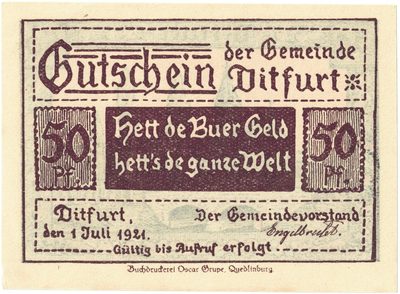
50 Pfennig, Gemeinde Ditfurt, 1921 (tobacco drying)
Gutschein der Gemeinde Ditfurt
What was happening
Notgeld - "emergency money" - began in 1914 when metal coin vanished into hoards, and by 1920 had become a collector's craze: towns commissioned decorative Gutscheine and Serienscheine printed far beyond any local need and sold to collectors, who paid real marks for paper the issuer hoped would never be redeemed.
Ditfurt is a village on the river Bode a few kilometres east of Quedlinburg, in what was then the Prussian Province of Saxony and is today Saxony-Anhalt. In 974 it was among the royal estates made over to the imperial abbess of Quedlinburg; its best-known 1921 notes are the woodcut egg-tax series (see [[notgeld-ditfurt-50-pfennig-eier]] and [[notgeld-ditfurt-50-pfennig-steuertag]]). This 50-pfennig piece is a separate note, not part of that woodcut series, closer in spirit to the village's plainer dialect Gutscheine.
The face carries the Low-German motto Hett de Buer Geld, hett's de ganze Welt - "if the farmer has money, he has the whole world" - a farmer's proverb fitting a note that celebrates the local crop. The back shows tobacco leaves hung up to dry over a view of the village, framed by an apple border. Tobacco was a cash crop of this corner of the Bode valley and the Halle lowlands, and the note sets its drying leaves against the village as a token of rural prosperity. Dated at Ditfurt, 1 July 1921, and signed by Engelbrecht, Gemeindevorstand.