Types / 1921
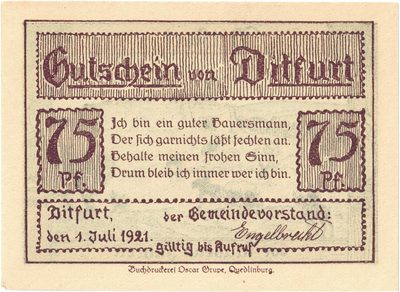
75 Pfennig, Gemeinde Ditfurt, 1921
Gutschein von Ditfurt
What was happening
Notgeld - "emergency money" - began in 1914 when metal coin vanished into hoards within weeks of mobilisation and the Reichsbank could not supply enough small change. Towns, districts and firms printed their own. By 1920 the shortage was easing but the craze was not: municipalities commissioned decorative Gutscheine, lithographed far beyond any local need and sold to collectors, who paid real marks for paper the town hoped would never be redeemed.
Ditfurt is a village on the river Bode a few kilometres east of Quedlinburg, in what was then the Prussian Province of Saxony and is today Saxony-Anhalt. In 974 the village was among the royal estates made over to the imperial abbess of Quedlinburg; its medieval dues to that abbey are the subject of the separate egg-tax woodcut series (see [[notgeld-ditfurt-50-pfennig-eier]] and [[notgeld-ditfurt-50-pfennig-steuertag]]). This note belongs to the plainer Gutschein von Ditfurt family, with a verse on the face and a colour scene on the back.
The face carries the proud little verse Ich bin ein guter Bauersmann, der sich garnichts läßt fechten an. Behalte meinen frohen Sinn, drum bleib ich immer wer ich bin - "I am a good farmer, who lets nothing trouble him; I keep my cheerful spirit, and so I stay forever who I am." The reddish back shows a vor tausend Jahren ("a thousand years ago") scene of ships on the water, evoking the village's great age. The note is dated at Ditfurt, 1 July 1921, and signed by Engelbrecht, Gemeindevorstand.