Types / 1923
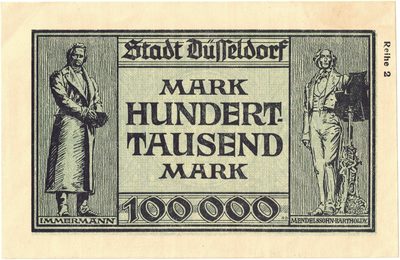
100 000 Mark, Stadt Düsseldorf, 1923
Notgeld der Stadt Düsseldorf
What was happening
By 1923 Notgeld had changed utterly from the small-change paper of 1914. Runaway inflation turned into outright hyperinflation that summer: prices doubled in days, then hours, and the Reichsbank's presses could not keep pace. Cities, districts and firms were authorised to print their own high-denomination emergency notes - Großnotgeld - simply to have enough paper money for a day's wages. This is money that belongs to the collapse of the currency, not to the collector albums of 1921.
Düsseldorf, the Rhineland capital on the lower Rhine, issued this 100 000-Mark note on 15 August 1923, marked "Reihe 2" (Series 2) and signed by the lord mayor (Der Oberbürgermeister). Within months even this sum would be trivial; by November a loaf cost billions. Despite the chaos the city gave the note a dignified design drawn from its own cultural past, honouring three men who made Düsseldorf a centre of the arts in the nineteenth century.
The face shows two statue figures: the writer Karl Immermann (1796-1840), the judge-turned-poet who directed the Düsseldorf municipal theatre in the 1830s and briefly raised it to real distinction, and the composer Felix Mendelssohn Bartholdy (1809-1847), who served as the city's municipal music director and conducted its Musikverein, writing music for the new theatre's opening. The back bears a portrait medallion, set between two arches, of the painter Peter von Cornelius (1783-1867), the Nazarene master who was called to reorganise the Düsseldorf art Academy and helped make its name. The note carries no individual serial, only the series mark.