Types / 1921
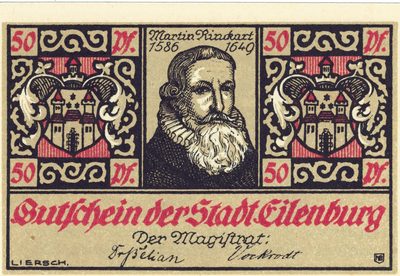
50 Pfennig, Stadt Eilenburg, 1921 (imperial troops, 1632)
Gutschein der Stadt Eilenburg
What was happening
Eilenburg is a walled town on the Mulde in the Prussian Province of Saxony. In 1921, like thousands of German towns, it printed decorative Serienscheine — emergency small change produced far beyond any real need, for sale to collectors. This set of six 50-Pfennig notes retells the town's ordeal in the Thirty Years' War and honours its most famous son, the pastor and hymn-writer Martin Rinckart (1586–1649).
Rinckart was born in Eilenburg, the son of a cooper, and returned in 1617 as archdeacon, serving through the whole war until his death. In the plague year of 1637 he was left as effectively the town's only remaining clergyman and is said to have buried the dead by the dozen — some four thousand that year, his own wife among them. Out of that catastrophe came the hymn for which he is remembered, "Nun danket alle Gott" ("Now Thank We All Our God"), set to music by Johann Crüger — a grace sung in the middle of the worst years of the war.
The front of every note in the set carries Rinckart's portrait between the town arms, over "Gutschein der Stadt Eilenburg / Der Magistrat" and the signatures of Dr. Belian and Vockrodt; the artist signed it "Liersch". The reverses, numbered 1 to 6, run through scenes of the war in and around the town. This note is scene 2: Kaiserliche Truppen unter Oberst Bredow begehren Einlaß in Eilenburg, Oktober 1632 — imperial troops under Colonel Bredow demanding entry to the walled town in October 1632, weeks before the battle of Lützen.
Valid until 30 September 1921.