Types / 1920
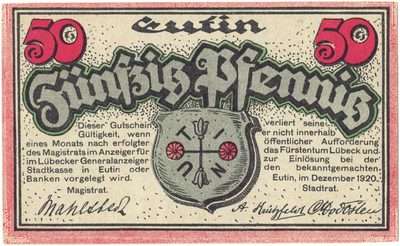
50 Pfennig, Stadt Eutin, 1920
Gutschein der Stadt Eutin
What was happening
Notgeld - "emergency money". German towns, districts and firms began printing their own small change in 1914, when silver and nickel coin disappeared into hoards within weeks of mobilisation, and did not really stop until the stabilisation of 1923.
What began as necessity turned into a craze. By 1920 municipalities were commissioning Serienscheine: lithographed sets aimed squarely at collectors, printed far beyond any local need, illustrated with local legends, landmarks, famous sons and jokes in dialect. Selling them was itself a way of raising money - the town took real marks for notes it hoped would never be presented for redemption. The result is the most inventive body of graphic design in the history of paper money, produced by places with a few thousand inhabitants.
Eutin is a small residence town in eastern Holstein, between two lakes, the seat of the prince-bishops of Luebeck and later of the dukes of Oldenburg - a court town of a few thousand people that in the late eighteenth century drew enough writers to be called the Weimar of the North.
The note is dated December 1920 and its redemption clause is unusually specific about where notice would be given: in the Anzeiger fuer das Fuerstentum Luebeck and the Luebecker Generalanzeiger, two newspapers, one month after the call. The reverse shows the Schloss across its water, framed in red roses.