Types / 1921
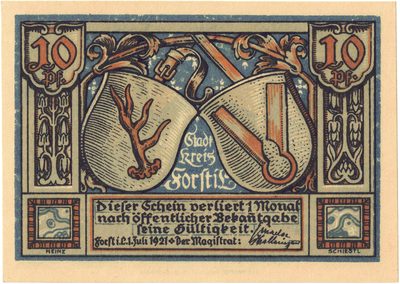
10 Pfennig, Stadt Forst (Lausitz), 1921 (weaving school)
Stadt Kreis Forst i.L.
What was happening
Notgeld began in 1914 out of necessity: coin vanished into hoards within weeks of mobilisation and towns printed their own small change because the Reichsbank could not supply enough.
By 1920 it had become something else. The shortage was easing but the collector market was not, and an issuer could take real marks for paper it hoped would never be presented. So towns, firms and clubs commissioned Serienscheine: lithographed sets, printed far beyond any local need, illustrated with whatever the place was proud of - a legend, a famous son, a battle, a trade, a joke in dialect. The result is the most inventive body of graphic design in the history of paper money, made in the years when Germany's currency was dying.
Forst on the Neisse was one of Germany's great cloth towns - some two hundred weaving mills in its heyday, and the nickname 'the German Manchester of Lusatia'. Its 1921 small-change notes take their subjects from that trade.
This one shows the town's weaving school with the wry couplet Es klagt der Fabrikant allein: das Tuch muss noch viel teurer sein - the manufacturer's only complaint is that the cloth ought to cost more still - an inflation-era joke on the price of textiles. The note ran out a month after it was publicly called in.