Types / 1921
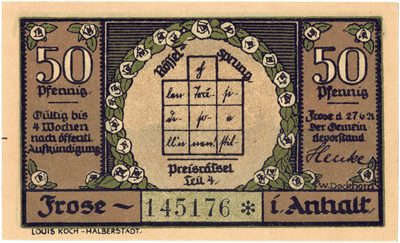
50 Pfennig, Gemeinde Frose, 1921 (Rösselsprung, Preisrätsel Teil 4)
Gemeinde Frose
What was happening
Notgeld began in 1914 out of necessity: coin vanished into hoards within weeks of mobilisation and towns printed their own small change because the Reichsbank could not supply enough.
By 1920 it had become something else. The shortage was easing but the collector market was not, and a town could take real marks for paper it hoped would never be presented. So the municipalities commissioned Serienscheine: lithographed sets, printed far beyond any local need, illustrated with whatever the place was proud of - a legend, a famous son, a battle, a joke in dialect. The result is the most inventive body of graphic design in the history of paper money, made in the years when Germany's currency was dying.
Frose is a small village in Anhalt, on the edge of a shallow lake between Aschersleben and Gernrode, and its set is one of the rare Preisrätsel (prize-puzzle) issues: the obverses carry puzzles - a Rösselsprung here, a picture-rebus elsewhere - and whoever solved them was to send the notes back in for a prize. The reverses are a local history in pictures. The design was drawn by W. Dockhorn and printed by Louis Koch in nearby Halberstadt, and the notes are dated "Frose, den 27. Juni 1921."
This value is marked "Preisrätsel Teil 4." Its obverse is a Rösselsprung, a word puzzle read by moving a chess knight from square to square to spell out a hidden verse. The reverse shows the flood-lake scene: the Überschwemmungsgebiet, the drowned ground that the note ties to the dam built by Bishop Gebhard in 1478. See the companion puzzles in the set, the [[notgeld-frose-50-pfennig-bilderraetsel]] and the Doppelschein [[notgeld-frose-1-mark-moench-nonne]].