Types / 1921
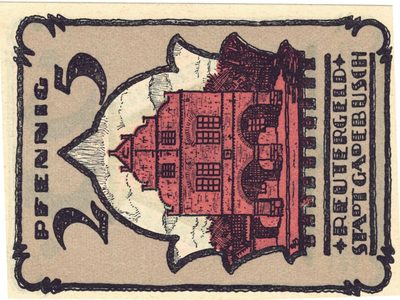
25 Pfennig, Stadt Gadebusch, 1921 (Reutergeld)
Reutergeld der Stadt Gadebusch
What was happening
Notgeld ("emergency money") began in 1914, when coin vanished into hoards within weeks of mobilisation and towns printed their own small change. By 1920-21 the shortage had eased but the collector craze had not, and municipalities issued Serienscheine - lithographed sets, printed far beyond any local need and sold to collectors for real marks the town hoped never to redeem.
Reutergeld was Mecklenburg's own version of the fashion. Around 1921 a number of Mecklenburg towns issued notes whose texts quoted the Low-German (Plattdeutsch) poet Fritz Reuter (1810-1874), the region's most beloved writer, born at Stavenhagen. The Stiftung Mecklenburg describes Reutergeld as a purely collectible issue without real payment function, spreading Reuter's dialect lines as a piece of regional self-advertisement and early tourism promotion. Stavenhagen, Bützow, Hagenow, Klütz and others took part; see the companion Klütz note [[notgeld-kluetz-reutergeld-25-pfennig]].
This is the 25 Pfennig of the Stadt Gadebusch, valid for local transactions until 31 December 1921 and signed by the Rat der Stadt. One face carries the value, the validity and a Reuter verse in Low German; the other a pictorial scene with the heading Reutergeld - Stadt Gadebusch. Gadebusch, a small town in western Mecklenburg-Schwerin, is best remembered for the Battle of Gadebusch (Wakenstädt) of December 1712, Sweden's last great victory on German soil in the Great Northern War.