Types / 1921
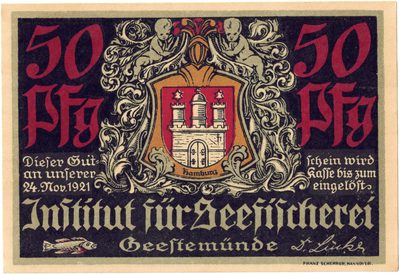
50 Pfennig, Institut für Seefischerei Geestemünde, 1921 (Hamburg arms / Frische Fische)
Institut für Seefischerei Geestemünde
What was happening
Notgeld began in 1914 out of necessity: coin vanished into hoards within weeks of mobilisation and towns printed their own small change because the Reichsbank could not supply enough.
By 1920 it had become something else. The shortage was easing but the collector market was not, and an issuer could take real marks for paper it hoped would never be presented. So towns, firms and institutions commissioned Serienscheine: lithographed sets printed far beyond any local need and illustrated with whatever the place was proud of - a legend, a famous son, a trade, a joke in dialect. The result is the most inventive body of graphic design in the history of paper money, made in the years when Germany's currency was dying.
Geestemünde, on the east bank of the Geeste where it meets the Weser estuary, grew in the late nineteenth century into one of Germany's great deep-sea fishing ports; the steam trawler fleet worked out of its fish harbour, and by 1913 scores of Fischdampfer were based there. (Geestemünde was joined to neighbouring Lehe and Wesermünde and is today part of Bremerhaven.) It was here that the Institut für Seefischerei (Sea-Fisheries Institute) was founded at the initiative of the local fishing industry to do applied research on fish processing and preservation and to train the fleet's captains and mates. The institute issued this fisheries-themed set, its captions in Low German, to be redeemed until 24 November 1921.
This 50-Pfennig note sets the arms of Hamburg - the white castle on red, flanked by two putti - on the obverse, and on the reverse a fish-shop and processing scene under the Plattdeutsch motto in praise of fresh fish. The companion note of the set carries the Geestemünde arms and a fishermen's scene; see [[notgeld-geestemuende-50-pfennig-fischersmann]].