Types / 1921
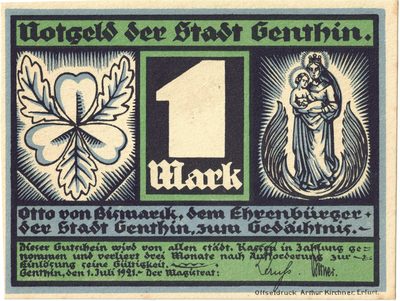
1 Mark, Stadt Genthin, 1921 (Bismarck memorial — "unsere Schuldigkeit tun")
Notgeld der Stadt Genthin
What was happening
Notgeld began in 1914 out of necessity: coin vanished into hoards within weeks of mobilisation and towns printed their own small change because the Reichsbank could not supply enough.
By 1920 it had become something else. The shortage was easing but the collector market was not, and a town could take real marks for paper it hoped would never be presented. So the municipalities commissioned Serienscheine: lithographed sets, printed far beyond any local need, illustrated with whatever the place was proud of - a legend, a famous son, a battle, a joke in dialect. The result is the most inventive body of graphic design in the history of paper money, made in the years when Germany's currency was dying.
Genthin, a small town in the Jerichower Land east of Magdeburg in what is now Saxony-Anhalt, made Otto von Bismarck an honorary citizen (Ehrenbürger). This set of five, dated "Genthin, den 1. Juli 1921" and printed in offset by Arthur Kirchner of Erfurt, was issued in his memory. Every note carries the same dedication - Otto von Bismarck, dem Ehrenbürger der Stadt Genthin, zum Gedächtnis - above a shared obverse: an oak-leaf and clover emblem to the left, the value numeral at the centre, and a crowned Madonna and Child standing in flames to the right. The reverses are the striking part: Expressionist woodcuts by Alfred Hanf of Erfurt, each a Bismarck portrait or allegory set against one of his sayings.
The 1-Mark note carries a woodcut of Bismarck in a hat and the saying Wir sind nicht auf dieser Welt um glücklich zu sein und zu geniessen, sondern um unsere Schuldigkeit zu tun - we are not in this world to be happy and to enjoy, but to do our duty. It runs with the [[notgeld-genthin-25-pfennig-bismarck]], [[notgeld-genthin-50-pfennig-bismarck]], [[notgeld-genthin-2-mark-bismarck]] and [[notgeld-genthin-5-mark-bismarck]].